
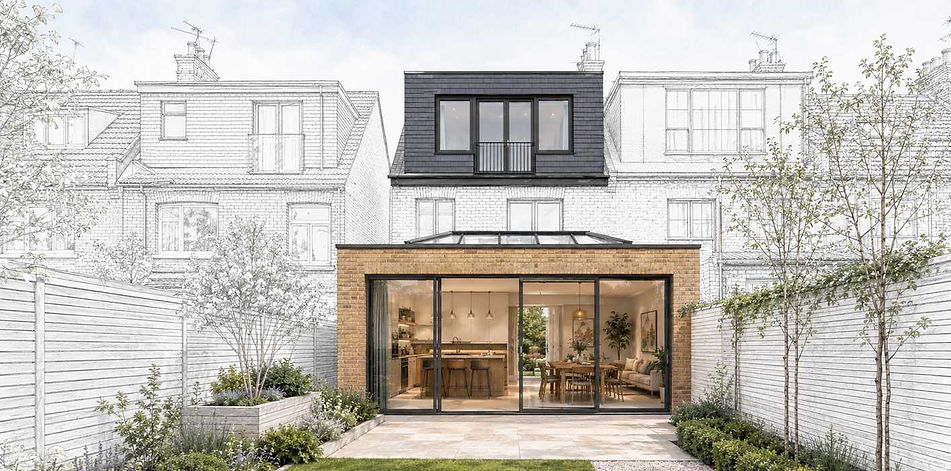
Extensions and Loft Conversions: Planning a Complete Home Transformation
Discover how the right combination of extension and loft conversion can create better living space, additional bedrooms and long-term value without overdeveloping your property.
Combining an extension with a loft conversion can completely transform a property.
An extension usually improves the way the ground floor works.
A loft conversion usually creates additional bedrooms, bathrooms or a quieter space away from the main living areas.
When the two are designed together properly, the result can be a home that feels larger, more practical and much better suited to modern family life.
However, there is no single standard package.
There are several popular types of extension, several different forms of loft conversion and a wide range of property styles.
The right solution for a Victorian terrace may be completely different from the best approach for a 1930s semi-detached house, a bungalow, a maisonette or a top-floor flat.
The aim should not simply be to build as much as possible.
A successful project adds the right space in the right places while keeping the overall design balanced.
Why Combine an Extension with a Loft Conversion?
Homeowners usually consider an extension and loft conversion for one of two reasons.
The first is practical.
They need more space for everyday life.
This may include:
-
A larger kitchen
-
A dining area
-
A family room
-
A home office
-
A utility room
-
A downstairs WC
-
Additional bedrooms
-
An en-suite
-
A larger family bathroom
-
Better storage
-
A quieter room for teenagers or guests
The second reason is longer-term value.
Some homeowners already have enough space for their current needs but recognise that a thoughtfully improved property may become more attractive and valuable in the future.
They may plan to remain in the home for several years and want to make sensible improvements while they have the opportunity.
A loft conversion and extension can both add value, but the design must still make sense.
Overextending a property can be expensive and may not always produce a proportionate return.
Extensions Improve Day-to-Day Living
An extension usually has the greatest effect on everyday family life.
The most popular projects include:
-
Rear extensions
-
Side-return extensions
-
Wraparound extensions
-
Full-width extensions
-
Single-storey side extensions
-
Double-storey extensions
-
Bungalow extensions
-
Kitchen-diner extensions
These can improve the kitchen, dining area and connection to the garden.
A rear or full-width extension may create a large kitchen, dining and family room.
A side-return extension can widen a narrow Victorian kitchen.
A wraparound extension can provide enough space for an island, dining table and seating area.
A single-storey side extension can add a utility room, study or playroom.
The ground-floor extension is usually where the family gathers, eats, entertains and spends most of its time.
Loft Conversions Add Bedrooms and Privacy
A loft conversion serves a different purpose.
It is usually the best way to create additional bedroom accommodation without reducing the garden or dramatically changing the footprint of the house.
Popular loft-conversion options include:
-
Rear dormer loft conversions
-
Hip-to-gable loft conversions
-
Hip-to-gable conversions with rear dormers
-
Mansard loft conversions
-
Rooflight loft conversions
-
L-shaped dormers
-
Bungalow loft conversions
-
Loft conversions above flats or maisonettes where the legal and planning position allows
A loft conversion may provide:
-
One larger bedroom
-
Two smaller bedrooms
-
A principal bedroom with en-suite
-
A guest room
-
A home office
-
A family bathroom
-
Storage
-
A quieter floor for older children
The best layout depends on the shape and height of the roof, the staircase position and the available headroom.
Choosing the Right Package for the Property
There are many possible combinations.
A Victorian terraced house may suit a side-return extension with a rear dormer loft conversion.
A semi-detached house may work well with a single-storey rear or side extension and a hip-to-gable loft conversion with a rear dormer.
A bungalow may benefit from a garden-facing extension combined with a carefully designed loft conversion.
A top-floor flat or maisonette may have the potential for a loft conversion, a rear addition or a roof-level extension, depending on the title, planning position and building structure.
The correct package needs to reflect:
-
The style of the property
-
The roof form
-
The garden size
-
The internal layout
-
Planning constraints
-
Permitted development rights
-
Structural considerations
-
The available budget
-
The likely value of the finished home
-
The homeowner’s long-term plans
The design should be tailored to the property rather than copied from another house.
Semi-Detached Houses Often Offer Excellent Opportunities
Semi-detached houses are among the most flexible properties for extension and loft-conversion projects.
They may have:
-
Space at the side
-
A reasonable rear garden
-
A hipped roof
-
A wider frontage
-
Better access for construction
-
Scope for a larger ground-floor layout
-
Potential for a substantial loft conversion
A popular and sensible package is often:
-
A single-storey side or rear extension
-
A hip-to-gable loft conversion
-
A rear dormer
-
A new bedroom or principal suite
-
An en-suite where the layout permits
-
A larger kitchen, dining and family space downstairs
This can create a significant improvement without overwhelming the original house.
Avoiding Overdevelopment
It is important to recognise when a scheme is becoming too ambitious.
For example, adding a large double-storey side extension and a substantial loft conversion to the same modest semi-detached house may not always be sensible.
The result could become visually heavy, structurally complex and expensive.
The finished property may also be much larger than neighbouring homes.
At that point, the cost of the building work may not be fully reflected in the eventual value of the house.
This does not mean that larger schemes should never be considered.
It means that the design needs to be proportionate.
A carefully planned single-storey extension with a good loft conversion may provide a better balance of:
-
Living space
-
Bedroom space
-
Cost
-
Planning prospects
-
Build complexity
-
Kerb appeal
-
Future resale value
The most successful project is not necessarily the biggest one.


Hip-to-Gable Loft Conversions
Many semi-detached houses have a hipped roof.
This means the roof slopes down at the side rather than rising to a full gable wall.
A simple rear dormer can sometimes produce a disappointing loft because the sloping side roof reduces the usable floor area.
Where the planning position allows, a hip-to-gable conversion can make a substantial difference.
The hipped side is built up to form a vertical gable wall.
A rear dormer can then be added.
This can create a much larger and more practical loft.
The result may provide enough space for:
-
A generous principal bedroom
-
An en-suite
-
Built-in wardrobes
-
A study area
-
Additional storage
-
Larger windows
-
A more usable staircase landing
For many semi-detached houses, the combination of a hip-to-gable conversion and rear dormer creates a far better result than a small dormer alone.
Rear Dormer Loft Conversions
Rear dormers remain one of the most popular loft-conversion options.
They extend out from the rear roof slope and create additional headroom and floor space.
A rear dormer may work well on:
-
Terraced houses
-
Semi-detached properties
-
End-of-terrace houses
-
Maisonettes
-
Flats with suitable roof rights
-
Bungalows
The design may include:
-
Full-height windows
-
French doors with a Juliet balcony
-
Anthracite-framed windows
-
Timber windows
-
Dark metal cladding
-
Slate hanging
-
Zinc-style finishes
-
Rendered panels
A well-proportioned dormer should feel integrated with the roof rather than oversized or visually clumsy.
Mansard Loft Conversions
A mansard loft conversion can create a particularly attractive and substantial upper floor.
It usually involves changing the rear roof slope to a steeper profile, often with dormer windows or larger glazed openings.
Mansards can be especially effective on period properties where the design is carefully detailed.
They may provide:
-
More usable floor area
-
Better headroom
-
A more balanced rear elevation
-
Larger bedrooms
-
Better bathroom layouts
-
A more architectural appearance
However, mansards usually require planning permission and can be more expensive than simpler dormer conversions.
L-Shaped Dormers
Some Victorian and Edwardian homes have a rear addition beneath a smaller roof.
Where the design and planning position allow, an L-shaped dormer may extend over both the main roof and the rear addition.
This can create significantly more usable loft space.
The additional area may allow for:
-
Two bedrooms
-
A bedroom and bathroom
-
A larger principal suite
-
Better storage
-
Improved circulation
-
A more practical landing
The structural and planning considerations need to be reviewed carefully, but the result can be impressive.
Flats and Maisonettes Can Also Have Potential
Extensions and loft conversions are not limited to conventional houses.
Some flats and maisonettes also have opportunities.
These may include:
-
Top-floor flats with access to the roof space
-
Ground-floor flats with private gardens
-
Converted Victorian properties
-
Maisonettes with rear additions
-
Flats with side-return areas
-
Properties with suitable ownership rights and leases
The legal position is particularly important.
Before developing a flat or maisonette, it may be necessary to confirm:
-
Ownership of the roof space
-
Rights over the garden
-
Lease restrictions
-
Freeholder consent
-
Planning requirements
-
Building Regulations
-
Party wall procedures
-
Access arrangements
-
Structural limitations
-
Fire-safety requirements
Where the rights and structure allow, the transformation can be substantial.
A modest flat may become a much larger and more valuable home.
Creating the Right Ground-Floor Layout
If an extension and loft conversion are being planned together, the ground-floor layout should still be treated as a separate design exercise.
The extension may create:
-
A larger kitchen
-
A dining area
-
A family seating space
-
A utility room
-
A downstairs WC
-
A home office
-
A playroom
-
Better storage
-
Larger garden doors
-
A level patio
The kitchen often sits closer to the centre of the house.
The dining and seating areas usually work well near the garden.
A kitchen island with stools can create a natural focal point.
Sliding doors, bi-fold doors or Crittall-style glazing can strengthen the connection to the patio.
Roof lanterns, rooflights and glazed roof sections can bring daylight back into the centre of the original home.
The Staircase Is Crucial
The staircase is one of the most important parts of any loft conversion.
A loft may look generous on paper, but the design can quickly become awkward if the staircase is poorly positioned.
Where possible, the new staircase should follow the general line of the existing staircase.
In many homes, the best solution is to continue the staircase above the existing flight so that it feels like a natural part of the house.
The new stairs may turn around the existing stairwell and rise into the loft landing.
This approach can:
-
Reduce the loss of bedroom space
-
Improve circulation
-
Create a more natural layout
-
Make the conversion feel integrated with the house
-
Avoid awkward box rooms
-
Improve headroom
-
Help the new floor feel like part of the original home
The staircase should be considered at the very beginning of the design process.
It should not be squeezed into the layout as an afterthought.
Doing the Loft Conversion First
Where the work is being phased, it is usually sensible to complete the loft conversion before the extension.
This is particularly important if the extension will include:
-
A new flat roof
-
A roof lantern
-
Expensive glazing
-
A finished patio
-
Landscaping
-
A large garden room
-
A delicate internal finish
The loft conversion may require scaffolding, access through the property and movement of materials.
It may also create disruption to the roof, ceilings and internal staircase.
Completing the loft first can help avoid damaging a newly finished extension.
Once the main loft work has been completed, the ground-floor extension can follow.
This sequence is often more practical and easier to manage.
Planning the Two Projects Together
Even where the work is phased, both projects should ideally be designed together.
This helps ensure that:
-
The overall massing remains balanced
-
The property is not overdeveloped
-
The staircase works properly
-
The ground-floor layout supports the upper floors
-
Services are coordinated
-
Drainage is considered
-
Structural design is integrated
-
The roof design is sensible
-
Future work does not undo earlier work
-
Budget decisions are made with the complete scheme in mind
A phased project should still have a clear long-term plan.
Designing only the first stage without considering the second can create expensive problems later.
Adding Value Without Building Too Much
Some homeowners approach extension and loft-conversion projects partly as an investment.
They want to improve the property and add value over the longer term.
This can be sensible, but the numbers should be considered carefully.
A good improvement may make the home:
-
More attractive to future buyers
-
Better suited to families
-
More flexible
-
More enjoyable to live in
-
Easier to sell
-
More valuable in the long term
However, the cost of the works needs to remain proportionate to the likely finished value.
The aim is not to create the largest possible property at any cost.
The aim is to create a well-designed home that offers a sensible balance between:
-
Build cost
-
Added space
-
Quality
-
Resale appeal
-
Planning prospects
-
Long-term value
Roof Design and External Appearance
The extension and loft conversion should feel like parts of one coherent design.
This does not mean that everything needs to match exactly.
A period house may look excellent with:
-
London stock brickwork
-
Black-framed doors
-
Dark fascia boards
-
Anthracite windows
-
A contemporary flat-roof extension
-
A dark-clad dormer
-
Slim roof lanterns
-
A level limestone-style patio
-
Carefully planned planting
A 1930s semi-detached house may suit:
-
A hip-to-gable loft conversion
-
A rear dormer
-
Matching roof tiles
-
A single-storey side extension
-
A rear kitchen extension
-
Rendered walls
-
Simpler glazing
-
A more suburban architectural style
The design should respect the character of the property while still creating a clear improvement.
Heating, Plumbing and Services
A larger home may need upgraded services.
A new loft bathroom and enlarged kitchen can increase the demand for hot water.
The heating engineer may need to consider:
-
Boiler capacity
-
Hot-water flow rates
-
Whether a combi boiler is suitable
-
Whether a hot-water cylinder is needed
-
Water pressure
-
New radiators
-
Underfloor heating
-
Drainage routes
-
Soil stacks
-
Bathroom positions
-
Kitchen plumbing
-
Ventilation
These decisions should be coordinated early.
The location of an en-suite bathroom may be influenced by drainage routes and the existing plumbing layout.
Likewise, the extension may create opportunities for underfloor heating or improved insulation.
Structural Design
Extensions and loft conversions both require careful structural design.
The engineer may need to consider:
-
Removal of load-bearing walls
-
Steel beams
-
Goalpost frames
-
Picture frames
-
Loft floor joists
-
Dormer structure
-
Roof alterations
-
Staircase openings
-
Foundations
-
Drainage
-
Large garden doors
-
Roof lantern openings
-
Existing walls
-
Existing foundations
Where the two projects are designed together, the structural strategy can be coordinated more efficiently.
This can reduce the risk of duplicated work or unexpected complications.
Planning Permission and Permitted Development
The planning position depends on the property, the type of extension, the type of loft conversion and the local context.
Some projects may be possible under permitted development rights.
Others will require planning permission.
Factors that may influence the position include:
-
Property type
-
Previous extensions
-
Roof form
-
Extension depth
-
Extension height
-
Dormer size
-
Conservation-area status
-
Article 4 directions
-
Flats and maisonettes
-
Listed-building status
-
Local planning policies
-
Neighbouring properties
Flats and maisonettes generally do not benefit from the same permitted development rights as houses.
A proper review is therefore essential.
Building Regulations
Building Regulations approval will normally be required.
The drawings and specifications may need to address:
-
Structure
-
Fire safety
-
Escape routes
-
Insulation
-
Ventilation
-
Staircase design
-
Headroom
-
Drainage
-
Heating
-
Electrical work
-
Roof construction
-
Glazing
-
Foundations
-
Sound insulation
-
Bathroom ventilation
-
Smoke alarms
Where a loft conversion creates a new upper floor, fire-safety requirements can be particularly important.
The whole escape route through the property may need to be reviewed.
Party Wall Considerations
Party wall procedures may apply where the work affects shared walls, chimney breasts, roof structures or neighbouring foundations.
This is particularly relevant for terraced and semi-detached properties.
A loft conversion may involve work to a shared party wall.
An extension may involve excavation close to neighbouring foundations.
The position should be reviewed before construction begins.
Getting Quotations from Builders
Builders can provide more reliable quotations when the design has been properly defined.
A coordinated package should show:
-
Existing and proposed floor plans
-
Existing and proposed elevations
-
Roof plans
-
Sections
-
Staircase design
-
Loft layout
-
Extension layout
-
Door and window sizes
-
Roof lanterns
-
Rooflights
-
Dormer details
-
Structural openings
-
Patio levels
-
Key finishes
-
Bathroom layouts
-
Utility layouts
-
Heating and plumbing changes
For more accurate quotations, Building Regulations drawings and structural information may also be helpful.
This makes it easier to compare quotations fairly and reduce the risk of unexpected extras.
Finding the Right Professionals
A combined extension and loft-conversion project may involve several professionals and trades, including:
-
Architectural designers
-
Planning consultants
-
Building Regulations designers
-
Structural engineers
-
Building Control professionals or approved inspectors
-
Party wall surveyors
-
Builders
-
Loft-conversion specialists
-
Roofing contractors
-
Steel fabricators
-
Staircase suppliers
-
Window and rooflight suppliers
-
Glazing specialists
-
Heating engineers
-
Plumbers
-
Electricians
-
Kitchen designers
-
Bathroom installers
-
Patio installers
-
Landscaping contractors
The Architectural Partner Network (APN) helps homeowners access vetted and approved professionals for different stages of their projects.
Whether you are exploring ideas, preparing for planning, comparing builder quotations or arranging a phased development, the right advice can help you make better decisions and avoid expensive mistakes.
Tell Us About Your Extension and Loft Conversion
A combined extension and loft conversion can completely transform a property.
You may want a larger kitchen and family room downstairs, additional bedrooms upstairs or a carefully planned phased development that adds long-term value.
Tell us a little about your property, your ideas and the stage you have reached. We can help point you towards the most appropriate professionals for the next step.